
Real Estate

Invests in residential properties to deliver rental income and capital appreciation – backed by tax efficiencies and the security of a tangible asset.

What is Real Estate?

Real estate refers to direct ownership or private investment in income-generating properties, rather than publicly traded real estate securities. Investors gain exposure to physical assets – such as multifamily apartments, office buildings, industrial warehouses, and retail centres – generally through private investment vehicles. Real estate offers stable tax-efficient rental income, potential capital appreciation, and inflation protection, often with low correlation to stock and bond markets, enhancing portfolio diversification. Strategies range from core (low risk, stabilized assets) to opportunistic (higher risk, value creation projects). While less liquid than publicly traded real estate, real estate investments can deliver attractive, risk-adjusted returns over long holding periods through professional asset management.

Why consider Real Estate for your portfolios?

Real estate generates consistent rental income, making it a reliable source of cash flow for investors.

Real estate serves as a natural hedge against inflation, as property values and rental income tend to rise with the cost of living. Many lease agreements are structured with inflation-adjusted rent increases, ensuring that real estate income keeps pace with rising prices. Unlike bonds, which lose value in an inflationary environment, real assets like real estate maintain intrinsic worth, making them an attractive store of value. Investors looking to preserve purchasing power often increase allocations to real estate during periods of elevated inflation.

Real estate has historically exhibited low correlation to public equities and fixed income. This helps investors reduce portfolio volatility and enhance risk-adjusted returns. This defensive characteristic makes real estate particularly valuable during periods of economic uncertainty.

Real estate can offer tax efficiency through flow-through income treatment, tax deferral, and strategic income allocation. Investors receive distributions that may include a mix of rental income, capital gains, and return of capital, with each component taxed differently. Return of capital (ROC) reduces an investor’s adjusted cost base, deferring taxes until units are sold, while capital gains taxation generally occurs only upon disposition (refer to Exhibit 1). The ability to defer and structure taxable events enhances after-tax returns, making real estate an effective tool for income generation and long-term wealth accumulation. Proper structuring can optimize tax outcomes while maintaining exposure to real estate’s benefits.

Exhibit 1: Hypothetical Private REIT Cash Distributions Taxed as Return of Capital (ROC)
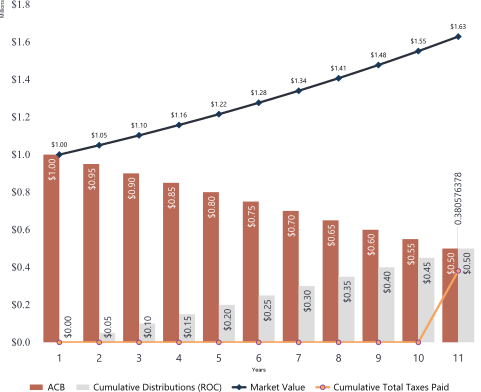
Source: Westcourt analysis. For illustrative purposes only.
Zoom Chart

Learn More About Our Real Estate Strategy